PostgreSQL Database Security as Code (Versioned)
Managing database security through ad-hoc GRANT and REVOKE commands leads to drift, and permissions
scattered across migration files make it hard to answer "who can access what?" Atlas lets you define
roles, users, permissions, and row-level security policies as code. With the versioned workflow, each
change is captured in a migration file, reviewed by your team, and applied through CI/CD.
This guide covers the versioned workflow. For the declarative approach, see the declarative security guide.
Roles, users, and permissions are available only to Atlas Pro users. To use this feature, run:
atlas login
Prerequisites
- Docker
- Atlas installed on your machine (installation guide)
- An Atlas Pro account (run
atlas loginto authenticate)
Project Setup
Start by spinning up a local PostgreSQL database using atlas tool docker:
export DATABASE_URL=$(atlas tool docker --url "docker://postgres/16/demo" --name my-db)
When you're done, stop the container with atlas tool docker kill --name my-db.
Create an atlas.hcl configuration file with roles and permissions enabled:
- Atlas DDL (HCL)
- SQL
env "local" {
  url = getenv("DATABASE_URL")
  dev = "docker://postgres/16/dev"
  schema {
    src = "file://schema.pg.hcl"
    mode {
      roles       = true   // Inspect and manage roles and users
      permissions = true   // Inspect and manage GRANT / REVOKE
    }
  }
}
env "local" {
  url = getenv("DATABASE_URL")
  dev = "docker://postgres/16/dev"
  schema {
    src = "file://schema.sql"
    mode {
      roles       = true
      permissions = true
    }
  }
}
Note that sensitive = ALLOW is not set here. In the versioned workflow, passwords are not included in
migration files by default. We will see how to inject them safely using
template directories later in this guide.
Roles and users are scoped to the instance rather than to a database, so with roles = true the desired state
is authoritative over every role and user Atlas inspects there. PostgreSQL's predefined pg_* roles are
excluded; anything else the migration directory creates and your schema file no longer declares is one
migrate diff plans to drop. Declare each with external = true: the role Atlas connects with, the admin,
replication roles, provider roles such as rds_superuser, and roles owned by other teams. See
Defining the Desired State.
Dev Database for Cloud Environments
When targeting cloud-managed databases (Amazon RDS, Cloud SQL, etc.), the dev database must know about
provider-specific roles that exist on the target but not in a vanilla PostgreSQL image. Use a docker
block with a baseline script to pre-create them:
docker "postgres" "rds" {
  image = "postgres:16"
  baseline = <<-SQL
   CREATE ROLE rds_superuser;
   CREATE ROLE rds_replication;
   CREATE ROLE rds_iam;
   CREATE ROLE rdsadmin;
   GRANT rds_superuser TO postgres;
  SQL
}

env "rds" {
  url = getenv("DATABASE_URL")
  dev = docker.postgres.rds.url
  schema {
    src = "file://schema.pg.hcl"
    mode {
      roles       = true
      permissions = true
    }
  }
  migration {
    dir = "file://migrations"
  }
}
If you prefer to use your own dev database instead of Docker, use a dev block:
dev "postgres" "rds" {
  url = getenv("DEV_URL")
  baseline = <<-SQL
   CREATE ROLE rds_superuser;
   CREATE ROLE rds_replication;
   CREATE ROLE rds_iam;
   CREATE ROLE rdsadmin;
   GRANT rds_superuser TO postgres;
  SQL
}
A dev database on the same instance as the target shares that instance's roles and users, so planning role
changes there collides with the live ones. Use a container, as in the docker block above, or point dev at
an instance of its own.
Managed Admin Users Such as postgres on Cloud SQL
On managed services, the admin user is not a real superuser, so Atlas reports its grants where a local dev
database hides them: postgres on Cloud SQL, the master user on RDS and Aurora (a member of
rds_superuser), the admin on Azure Flexible Server (azure_pg_admin), and the admin on AlloyDB
(alloydbsuperuser).
Why this happens and how to exclude the admin user
On Cloud SQL for PostgreSQL, the bootstrap superuser is Google's cloudsqladmin. The postgres user is
created afterwards as an ordinary role: it is not a superuser, it gets CREATEROLE and CREATEDB through
membership in cloudsqlsuperuser, and its OID is above the system range. On a local container, the same
postgres is the bootstrap superuser.
Atlas skips the superuser's implicit grants on a local dev database, but on Cloud SQL postgres is a regular
role, so its grants show up in inspection and in every diff. To skip its management and drop it from
inspection, add:
env "staging" {
  url = getenv("DATABASE_URL")
  dev = "docker://postgres/16/dev"
  exclude = [
    "postgres[type=role|user]",
    "postgres[type=role|user].permission",
  ]
}
The first pattern removes only the role object, since many projects exclude roles but still manage grants
to them. The second removes the grants. Declaring the role with external = true covers the role in the
same way and still needs the second pattern for its grants.
Grants to postgres cannot be planned through a local dev database, because PostgreSQL makes them
implicit for a superuser. To manage them, use a dev database where postgres is an ordinary role, such as
a second Cloud SQL instance. The other providers behave the same: use the two patterns with that admin's
name.
Defining the Desired State
The schema file is the target state Atlas diffs against the migration directory. Let's model a SaaS order management application with tiered access:
| Role | Purpose |
|---|---|
app_readonly | Read-only access for reporting dashboards |
app_writer | Read-write access for the application backend, inherits from app_readonly |
app_admin | Full administrative access, inherits from app_writer |
Two login users:
| User | Role membership |
|---|---|
dashboard_user | app_readonly |
api_user | app_writer |
- Atlas DDL (HCL)
- SQL
variable "api_password" {
  type = string
}

variable "dashboard_password" {
  type = string
}

role "app_readonly" {
  comment = "Read-only access for reporting"
}

role "app_writer" {
  comment   = "Read-write access for the application"
  member_of = [role.app_readonly]
}

role "app_admin" {
  create_role = true
  comment     = "Administrative access"
  member_of   = [role.app_writer]
}

user "dashboard_user" {
  password   = var.dashboard_password
  conn_limit = 5
  comment    = "Reporting dashboard service account"
  member_of  = [role.app_readonly]
}

user "api_user" {
  password   = var.api_password
  conn_limit = 20
  comment    = "Application API service account"
  member_of  = [role.app_writer]
}

table "users" {
  schema = schema.public
  column "id" {
    type = serial
    null = false
  }
  column "name" {
    type = character_varying
    null = false
  }
  column "email" {
    type = character_varying
    null = false
  }
  primary_key {
    columns = [column.id]
  }
}

table "products" {
  schema = schema.public
  column "id" {
    type = serial
    null = false
  }
  column "name" {
    type = character_varying
    null = false
  }
  column "price" {
    type = numeric
    null = false
  }
  primary_key {
    columns = [column.id]
  }
}

table "orders" {
  schema = schema.public
  column "id" {
    type = serial
    null = false
  }
  column "user_id" {
    type = integer
    null = false
  }
  column "product_id" {
    type = integer
    null = false
  }
  column "tenant_id" {
    type = integer
    null = false
  }
  column "total" {
    type = numeric
    null = false
  }
  primary_key {
    columns = [column.id]
  }
  foreign_key "fk_order_user" {
    columns     = [column.user_id]
    ref_columns = [table.users.column.id]
  }
  foreign_key "fk_order_product" {
    columns     = [column.product_id]
    ref_columns = [table.products.column.id]
  }
  row_security {
    enabled  = true
    enforced = true
  }
}

function "get_order_total" {
  schema = schema.public
  lang   = PLpgSQL
  arg "order_id" {
    type = integer
  }
  return = numeric
  as     = <<-SQL
  DECLARE
    result numeric;
  BEGIN
    SELECT total INTO result FROM orders WHERE id = order_id;
    RETURN result;
  END;
  SQL
}

procedure "archive_old_orders" {
  schema = schema.public
  lang   = PLpgSQL
  arg "cutoff_days" {
    type = integer
  }
  as = <<-SQL
  BEGIN
    DELETE FROM orders WHERE id IN (
      SELECT id FROM orders LIMIT cutoff_days
    );
  END;
  SQL
}

materialized "order_summary" {
  schema = schema.public
  column "product_id" {
    null = false
    type = integer
  }
  column "product_name" {
    null = false
    type = character_varying
  }
  column "total_orders" {
    type = bigint
  }
  column "total_revenue" {
    type = numeric
  }
  as = "SELECT p.id AS product_id, p.name AS product_name, count(*) AS total_orders, sum(o.total) AS total_revenue FROM orders o JOIN products p ON o.product_id = p.id GROUP BY p.id, p.name"
}

// Admin gets ALL on the schema with grant option
permission {
  to         = role.app_admin
  for        = schema.public
  privileges = [ALL]
  grantable  = true
}

// Read-only: SELECT on all tables
permission {
  for_each   = [table.orders, table.products, table.users]
  for        = each.value
  to         = role.app_readonly
  privileges = [SELECT]
}

// Writer: SELECT, INSERT, UPDATE on orders and products
permission {
  for_each   = [table.orders, table.products]
  for        = each.value
  to         = role.app_writer
  privileges = [SELECT, INSERT, UPDATE]
}

// Column-level: api_user can only UPDATE the email column
permission {
  to         = user.api_user
  for        = table.users.column.email
  privileges = [UPDATE]
}

// Function-level: app_readonly can call get_order_total
permission {
  to         = role.app_readonly
  for        = function.get_order_total
  privileges = [EXECUTE]
}

// Procedure-level: only app_admin can call archive_old_orders
permission {
  to         = role.app_admin
  for        = procedure.archive_old_orders
  privileges = [EXECUTE]
}

// Materialized view: app_readonly can SELECT from the summary
permission {
  to         = role.app_readonly
  for        = materialized.order_summary
  privileges = [SELECT]
}

policy "tenant_isolation" {
  on    = table.orders
  for   = ALL
  to    = ["app_writer"]
  using = "(tenant_id = current_setting('app.current_tenant')::integer)"
  check = "(tenant_id = current_setting('app.current_tenant')::integer)"
}

schema "public" {
  comment = "standard public schema"
}
-- Create roles
CREATE ROLE "app_readonly";
COMMENT ON ROLE "app_readonly" IS 'Read-only access for reporting';

CREATE ROLE "app_writer" IN ROLE "app_readonly";
COMMENT ON ROLE "app_writer" IS 'Read-write access for the application';

CREATE ROLE "app_admin" CREATEROLE IN ROLE "app_writer";
COMMENT ON ROLE "app_admin" IS 'Administrative access';

-- Create users
CREATE USER "dashboard_user" PASSWORD '<sensitive>' CONNECTION LIMIT 5 IN ROLE "app_readonly";
COMMENT ON ROLE "dashboard_user" IS 'Reporting dashboard service account';

CREATE USER "api_user" PASSWORD '<sensitive>' CONNECTION LIMIT 20 IN ROLE "app_writer";
COMMENT ON ROLE "api_user" IS 'Application API service account';

-- Create tables
CREATE TABLE "users" (
  "id" serial NOT NULL,
  "name" character varying NOT NULL,
  "email" character varying NOT NULL,
  PRIMARY KEY ("id")
);

CREATE TABLE "products" (
  "id" serial NOT NULL,
  "name" character varying NOT NULL,
  "price" numeric NOT NULL,
  PRIMARY KEY ("id")
);

CREATE TABLE "orders" (
  "id" serial NOT NULL,
  "user_id" integer NOT NULL,
  "product_id" integer NOT NULL,
  "tenant_id" integer NOT NULL,
  "total" numeric NOT NULL,
  PRIMARY KEY ("id"),
  FOREIGN KEY ("user_id") REFERENCES "users" ("id"),
  FOREIGN KEY ("product_id") REFERENCES "products" ("id")
);

-- Functions
CREATE FUNCTION "get_order_total" ("order_id" integer) RETURNS numeric LANGUAGE plpgsql AS $$
DECLARE
  result numeric;
BEGIN
  SELECT total INTO result FROM orders WHERE id = order_id;
  RETURN result;
END;
$$;

-- Procedures
CREATE PROCEDURE "archive_old_orders" ("cutoff_days" integer) LANGUAGE plpgsql AS $$
BEGIN
  DELETE FROM orders WHERE id IN (
    SELECT id FROM orders LIMIT cutoff_days
  );
END;
$$;

-- Materialized views
CREATE MATERIALIZED VIEW "order_summary" AS
  SELECT p.id AS product_id, p.name AS product_name, count(*) AS total_orders, sum(o.total) AS total_revenue
  FROM orders o JOIN products p ON o.product_id = p.id
  GROUP BY p.id, p.name;

-- Permissions
GRANT ALL ON SCHEMA "public" TO "app_admin" WITH GRANT OPTION;

GRANT SELECT ON TABLE "orders" TO "app_readonly";
GRANT SELECT ON TABLE "products" TO "app_readonly";
GRANT SELECT ON TABLE "users" TO "app_readonly";

GRANT SELECT, INSERT, UPDATE ON TABLE "orders" TO "app_writer";
GRANT SELECT, INSERT, UPDATE ON TABLE "products" TO "app_writer";

GRANT UPDATE ("email") ON TABLE "users" TO "api_user";

-- Function and procedure grants
GRANT EXECUTE ON FUNCTION "get_order_total" TO "app_readonly";
GRANT EXECUTE ON PROCEDURE "archive_old_orders" TO "app_admin";

-- Materialized view grants
GRANT SELECT ON "order_summary" TO "app_readonly";

-- Row-level security
ALTER TABLE "orders" ENABLE ROW LEVEL SECURITY;
ALTER TABLE "orders" FORCE ROW LEVEL SECURITY;

CREATE POLICY "tenant_isolation" ON "orders"
  FOR ALL
  TO "app_writer"
  USING (tenant_id = current_setting('app.current_tenant')::integer)
  WITH CHECK (tenant_id = current_setting('app.current_tenant')::integer);
Cloud-managed databases (Amazon RDS, Google Cloud SQL, Azure) include provider-specific roles like
rds_superuser or cloudsqlsuperuser. PostgreSQL also ships with
predefined roles like pg_read_all_data
and pg_monitor. Mark these roles as external = true so Atlas knows they already exist and will only
generate the GRANT, never a CREATE ROLE:
// PostgreSQL predefined role
role "pg_read_all_data" {
  external = true
}

// Cloud provider role (e.g., Amazon RDS)
role "rds_superuser" {
  external = true
}

role "app_readonly" {
  comment   = "Read-only access for reporting"
  member_of = [role.pg_read_all_data]
}
Generating the Initial Migration
Run atlas migrate diff to generate the first migration file:
atlas migrate diff add_security \
  --env local \
  --var "api_password=s3cret" \
  --var "dashboard_password=r3port"
Atlas creates a migration directory with the generated SQL and a checksum file:
migrations/
├── 20260303120000_add_security.sql
└── atlas.sum
The generated migration contains every role, grant, table, function, procedure, materialized view, policy, and RLS setting:
-- Create role "app_readonly"
CREATE ROLE "app_readonly";
-- Create role "app_writer"
CREATE ROLE "app_writer";
-- Grant role "app_readonly" to "app_writer"
GRANT "app_readonly" TO "app_writer";
-- Create role "app_admin"
CREATE ROLE "app_admin" WITH CREATEROLE;
-- Grant role "app_writer" to "app_admin"
GRANT "app_writer" TO "app_admin";
-- Grant on schema "public" to "app_admin"
GRANT CREATE, USAGE ON SCHEMA "public" TO "app_admin" WITH GRANT OPTION;
-- Create user "api_user"
CREATE ROLE "api_user" WITH LOGIN CONNECTION LIMIT 20;
-- Grant role "app_writer" to "api_user"
GRANT "app_writer" TO "api_user";
-- Create user "dashboard_user"
CREATE ROLE "dashboard_user" WITH LOGIN CONNECTION LIMIT 5;
-- Grant role "app_readonly" to "dashboard_user"
GRANT "app_readonly" TO "dashboard_user";
-- Create "products" table
CREATE TABLE "public"."products" (
  "id" serial NOT NULL,
  "name" character varying NOT NULL,
  "price" numeric NOT NULL,
  PRIMARY KEY ("id")
);
-- Grant on table "products" to "app_readonly"
GRANT SELECT ON TABLE "public"."products" TO "app_readonly";
-- Grant on table "products" to "app_writer"
GRANT INSERT, SELECT, UPDATE ON TABLE "public"."products" TO "app_writer";
-- Create "users" table
CREATE TABLE "public"."users" (
  "id" serial NOT NULL,
  "name" character varying NOT NULL,
  "email" character varying NOT NULL,
  PRIMARY KEY ("id")
);
-- Grant on table "users" to "app_readonly"
GRANT SELECT ON TABLE "public"."users" TO "app_readonly";
-- Grant on column "email" of table "users" to "api_user"
GRANT UPDATE ("email") ON TABLE "public"."users" TO "api_user";
-- Create "orders" table
CREATE TABLE "public"."orders" (
  "id" serial NOT NULL,
  "user_id" integer NOT NULL,
  "product_id" integer NOT NULL,
  "tenant_id" integer NOT NULL,
  "total" numeric NOT NULL,
  PRIMARY KEY ("id"),
  CONSTRAINT "fk_order_product" FOREIGN KEY ("product_id") REFERENCES "public"."products" ("id") ON UPDATE NO ACTION ON DELETE NO ACTION,
  CONSTRAINT "fk_order_user" FOREIGN KEY ("user_id") REFERENCES "public"."users" ("id") ON UPDATE NO ACTION ON DELETE NO ACTION
);
-- Enable and enforce row-level security for "orders" table
ALTER TABLE "public"."orders" ENABLE ROW LEVEL SECURITY, FORCE ROW LEVEL SECURITY;
-- Grant on table "orders" to "app_readonly"
GRANT SELECT ON TABLE "public"."orders" TO "app_readonly";
-- Grant on table "orders" to "app_writer"
GRANT INSERT, SELECT, UPDATE ON TABLE "public"."orders" TO "app_writer";
-- Create policy "tenant_isolation"
CREATE POLICY "tenant_isolation" ON "public"."orders" AS PERMISSIVE FOR ALL TO "app_writer"
  USING (tenant_id = (current_setting('app.current_tenant'::text))::integer)
  WITH CHECK (tenant_id = (current_setting('app.current_tenant'::text))::integer);
-- Create "get_order_total" function
CREATE FUNCTION "public"."get_order_total" ("order_id" integer) RETURNS numeric LANGUAGE plpgsql AS $$
DECLARE
  result numeric;
BEGIN
  SELECT total INTO result FROM orders WHERE id = order_id;
  RETURN result;
END;
$$;
-- Grant on function "get_order_total" to "PUBLIC"
GRANT EXECUTE ON FUNCTION "public"."get_order_total" TO PUBLIC;
-- Grant on function "get_order_total" to "app_readonly"
GRANT EXECUTE ON FUNCTION "public"."get_order_total" TO "app_readonly";
-- Create "archive_old_orders" procedure
CREATE PROCEDURE "public"."archive_old_orders" ("cutoff_days" integer) LANGUAGE plpgsql AS $$
BEGIN
  DELETE FROM orders WHERE id IN (
    SELECT id FROM orders LIMIT cutoff_days
  );
END;
$$;
-- Grant on procedure "archive_old_orders" to "PUBLIC"
GRANT EXECUTE ON PROCEDURE "public"."archive_old_orders" TO PUBLIC;
-- Grant on procedure "archive_old_orders" to "app_admin"
GRANT EXECUTE ON PROCEDURE "public"."archive_old_orders" TO "app_admin";
-- Create "order_summary" view
CREATE MATERIALIZED VIEW "public"."order_summary" (
  "product_id",
  "product_name",
  "total_orders",
  "total_revenue"
) AS SELECT p.id AS product_id, p.name AS product_name, count(*) AS total_orders, sum(o.total) AS total_revenue
  FROM (public.orders o JOIN public.products p ON ((o.product_id = p.id)))
  GROUP BY p.id, p.name;
-- Grant on view "order_summary" to "app_readonly"
GRANT SELECT ON "public"."order_summary" TO "app_readonly";
Notice that passwords are not included. Atlas intentionally excludes them from versioned migration files - secrets should never be committed to source control.
Adding Passwords with Template Directories
To set passwords at deploy time, add ALTER ROLE ... PASSWORD statements to the migration and mark them
with the -- atlas:sensitive directive so the values are never logged:
-- atlas:sensitive
ALTER ROLE "api_user" WITH PASSWORD '{{ .api_password }}';
-- atlas:sensitive
ALTER ROLE "dashboard_user" WITH PASSWORD '{{ .dashboard_password }}';
Then configure a template directory in atlas.hcl to inject
the actual values at runtime:
variable "api_password" {
  type    = string
  default = "changeme"
}

variable "dashboard_password" {
  type    = string
  default = "changeme"
}

data "template_dir" "migrations" {
  path = "migrations"
  vars = {
    api_password       = var.api_password
    dashboard_password = var.dashboard_password
  }
}

env "local" {
  url = getenv("DATABASE_URL")
  dev = "docker://postgres/16/dev"
  schema {
    src = "file://schema.pg.hcl"
    mode {
      roles       = true
      permissions = true
    }
  }
  migration {
    dir = data.template_dir.migrations.url
  }
}
At deploy time, {{ .api_password }} and {{ .dashboard_password }} are replaced with real values from
the template_dir vars. Source these from environment variables, or use the
runtimevar data source to read passwords directly from AWS Secrets Manager,
GCP Secret Manager, HashiCorp Vault, or any other supported secret store:
data "runtimevar" "api_pass" {
  url = "awssecretsmanager://api-db-password?region=us-east-1"
}

data "template_dir" "migrations" {
  path = "migrations"
  vars = {
    api_password = data.runtimevar.api_pass
  }
}
To assume an IAM role when reading the secret, use AWS SDK v2 mode and append
&awssdk=v2&role=arn:aws:iam::<account-id>:role/<role-name>.
Applying Migrations
Apply to the target database:
atlas migrate apply --env local \
  --var "api_password=$API_PASSWORD" \
  --var "dashboard_password=$DASHBOARD_PASSWORD"
Migrating to version 20260303120000 (1 migration in total):

  -- migrating version 20260303120000
    -> CREATE ROLE "app_readonly";
    -> CREATE ROLE "app_writer";
    -> GRANT "app_readonly" TO "app_writer";
    -> CREATE ROLE "app_admin" WITH CREATEROLE;
    -> GRANT "app_writer" TO "app_admin";
    -> GRANT CREATE, USAGE ON SCHEMA "public" TO "app_admin" WITH GRANT OPTION;
    -> CREATE ROLE "api_user" WITH LOGIN CONNECTION LIMIT 20;
    -> GRANT "app_writer" TO "api_user";
    -> CREATE ROLE "dashboard_user" WITH LOGIN CONNECTION LIMIT 5;
    -> GRANT "app_readonly" TO "dashboard_user";
    -> CREATE TABLE "public"."products" ( ... );
    -> GRANT SELECT ON TABLE "public"."products" TO "app_readonly";
    -> GRANT INSERT, SELECT, UPDATE ON TABLE "public"."products" TO "app_writer";
    -> CREATE TABLE "public"."users" ( ... );
    -> GRANT SELECT ON TABLE "public"."users" TO "app_readonly";
    -> GRANT UPDATE ("email") ON TABLE "public"."users" TO "api_user";
    -> CREATE TABLE "public"."orders" ( ... );
    -> ALTER TABLE "public"."orders" ENABLE ROW LEVEL SECURITY, FORCE ROW LEVEL SECURITY;
    -> GRANT SELECT ON TABLE "public"."orders" TO "app_readonly";
    -> GRANT INSERT, SELECT, UPDATE ON TABLE "public"."orders" TO "app_writer";
    -> CREATE POLICY "tenant_isolation" ON "public"."orders" ...
    -> CREATE FUNCTION "public"."get_order_total" ...
    -> GRANT EXECUTE ON FUNCTION "public"."get_order_total" TO PUBLIC;
    -> GRANT EXECUTE ON FUNCTION "public"."get_order_total" TO "app_readonly";
    -> CREATE PROCEDURE "public"."archive_old_orders" ...
    -> GRANT EXECUTE ON PROCEDURE "public"."archive_old_orders" TO PUBLIC;
    -> GRANT EXECUTE ON PROCEDURE "public"."archive_old_orders" TO "app_admin";
    -> CREATE MATERIALIZED VIEW "public"."order_summary" ( ... ) AS SELECT ...;
    -> GRANT SELECT ON "public"."order_summary" TO "app_readonly";
  -- ok

  -------------------------
  -- 1 migration
  -- 29 sql statements
With Atlas Cloud, push your migration directory and deploy from any CI/CD platform:
atlas migrate push app --env local
Making Incremental Changes
When requirements change, update the schema file and generate a new migration. Atlas computes only the
diff. For example, adding an app_support role for the support team:
- Atlas DDL (HCL)
- SQL
Add to schema.pg.hcl:
role "app_support" {
  comment   = "Support team access"
  member_of = [role.app_readonly]
}

// Support can view and update orders
permission {
  to         = role.app_support
  for        = table.orders
  privileges = [SELECT, UPDATE]
}
Add to schema.sql:
CREATE ROLE "app_support" IN ROLE "app_readonly";
COMMENT ON ROLE "app_support" IS 'Support team access';

GRANT SELECT, UPDATE ON TABLE "orders" TO "app_support";
Generate the incremental migration:
atlas migrate diff add_support_role \
  --env local \
  --var "api_password=s3cret" \
  --var "dashboard_password=r3port"
Atlas generates only what changed - the new role and its grants:
-- Create role "app_support"
CREATE ROLE "app_support";
-- Grant role "app_readonly" to "app_support"
GRANT "app_readonly" TO "app_support";
-- Grant on table "orders" to "app_support"
GRANT SELECT ON TABLE "public"."orders" TO "app_support";
-- Grant on table "orders" to "app_support"
GRANT UPDATE ON TABLE "public"."orders" TO "app_support";
The migration directory now holds both files. The sum of all migrations represents the current security state:
migrations/
├── 20260303120000_add_security.sql
├── 20260303130000_add_support_role.sql
└── atlas.sum
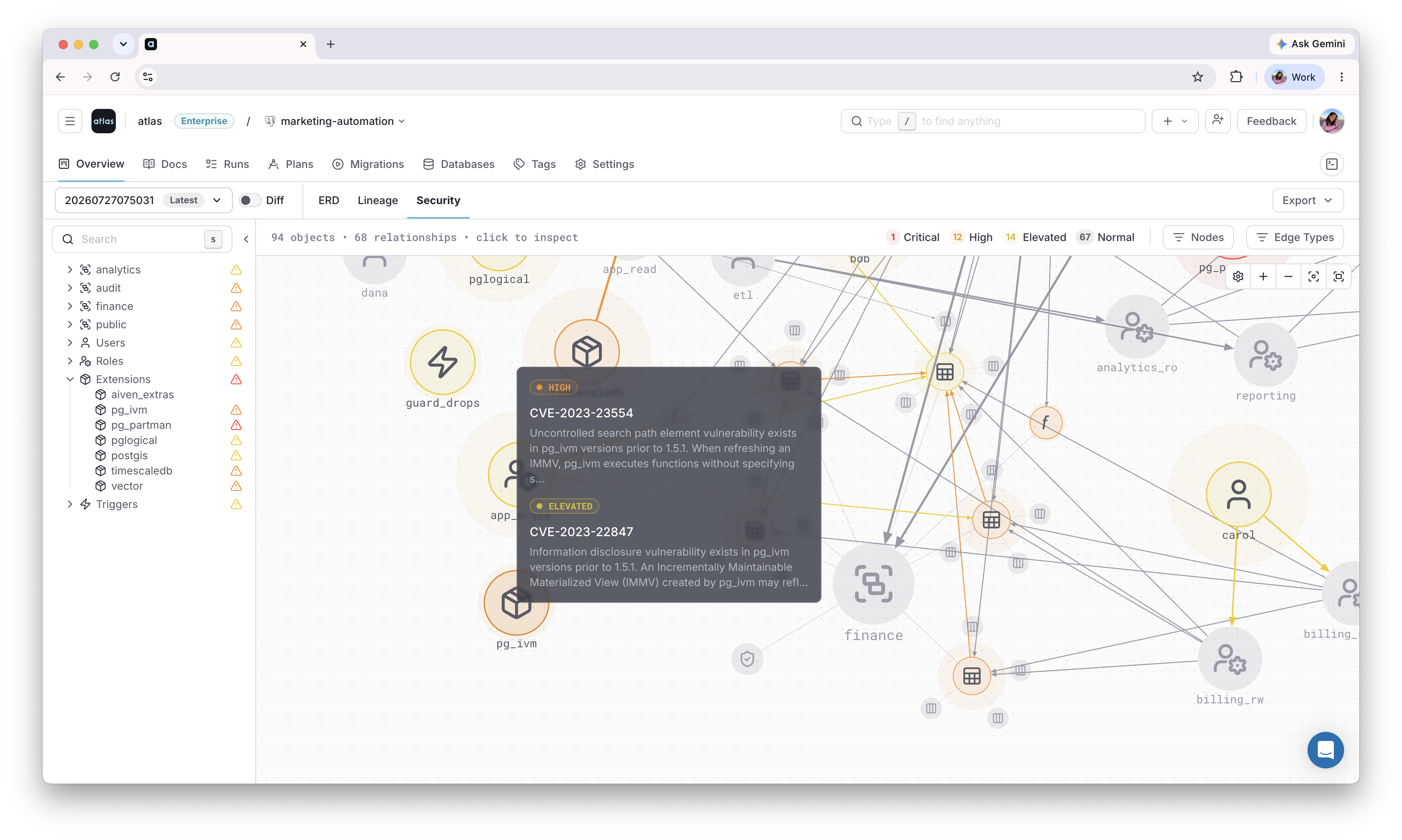
Visualize on Atlas Registry
Once these roles, grants, and policies are applied, use the Security Graph to see how they connect across the repository, and flag any risky access patterns automatically.
Next Steps
- Declarative workflow - describe the desired state and let Atlas figure out the diff
- Template directories - inject passwords at deploy time without exposing them in source control
- HCL reference - all role and permission attributes
- CI/CD setup - deploy versioned migrations to production
Have questions? Feedback? Find our team on our Discord server or schedule a demo.